
Sunday, November 8, 2026
The Scripture
Amos 5:18-24
Woe to you who desire the day of the Lord!
Why do you want the day of the Lord?
It is darkness, not light,
as if someone fled from a lion
and was met by a bear
or went into the house and rested a hand against the wall
and was bitten by a snake.
Is not the day of the Lord darkness, not light,
and gloom with no brightness in it?
I hate, I despise your festivals,
and I take no delight in your solemn assemblies.
Even though you offer me your burnt offerings and grain offerings,
I will not accept them,
and the offerings of well-being of your fatted animals
I will not look upon.
Take away from me the noise of your songs;
I will not listen to the melody of your harps.
But let justice roll down like water
and righteousness like an ever-flowing stream.
Matthew 25:1-13
“Then the kingdom of heaven will be like this. Ten young women took their lamps and went to meet the bridegroom. Five of them were foolish, and five were wise. Then the foolish took their lamps, they took no oil with them, but the wise took flasks of oil with their lamps. As the bridegroom was delayed, all of them became drowsy and slept. But at midnight there was a shout, ‘Look! Here is the bridegroom! Come out to meet him.’ Then all those young women got up and trimmed their lamps. The foolish said to the wise, ‘Give us some of your oil, for our lamps are going out.’ But the wise replied, ‘No! there will not be enough for you and for us; you had better go to the dealers and buy some for yourselves.’ And while they went to buy it, the bridegroom came, and those who were ready went with him into the wedding banquet, and the door was shut. Later the other young women came also, saying, ‘Lord, lord, open to us.’ But he replied, ‘Truly I tell you, I do not know you.’ Keep awake, therefore, for you know neither the day nor the hour.”
The Sermon
There’s a song that was written a while back by a man named Larry Norman called “I Wish We’d All Been Ready”. I don’t know if you’ve ever heard of it, but it was popular in Christian circles. It goes like this: “Life was filled with guns and war and everyone got trampled on the floor – I wish we’d all been ready. Children died, the days grew cold; a piece of bread could buy a bag of gold – I wish we’d all been ready. There’s no time to change your mind; the Son has come and you’ve been left behind. A man and wife asleep in bed. She hears a noise and turns her head; he’s gone – I wish we’d all been ready. Two men walking up a hill – one disappears and one’s left standing still – I wish we’d all been ready. There’s no time to change your mind; the Son has come and you’ve been left behind.”
Do you remember this? Do you know people who believe this? Do you believe this could happen?
What I find fascinating about this song is that it was written in 1969. Fifty-seven years ago. It seems like just yesterday. And I myself felt the sentiment of this song, and somewhere in the late 1970s or early 1980s I probably sang it several times.
Several years ago there were also books and movies called “The Left Behind Series”, published and shown between 1995 and 2007. Think of that. Between around 20 and 30 years ago. And here we still are. Just watch out – the person in the pew next to you might disappear – or maybe all of you will disappear and I’ll still be standing here…left behind!
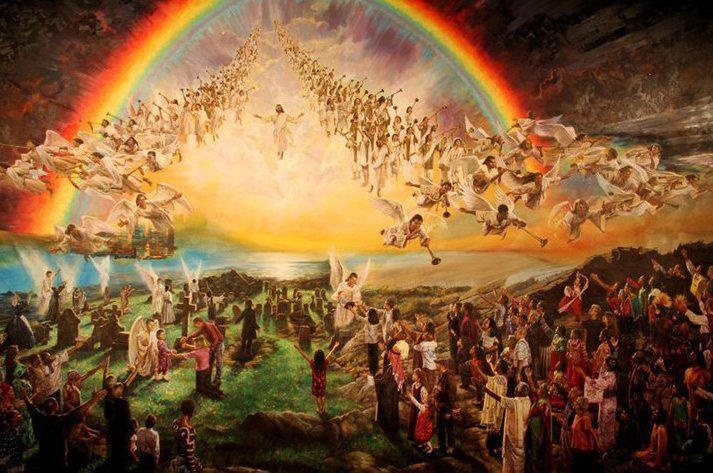
But there are people who believe this, and we continue, even since the day the whole concept of “the day of the Lord” was conceived of and spoken, to wait for something…a day, a time, a development, a catastrophe or perhaps a joyous celebratory rescue…and we ask ourselves and others, “are you ready?”
Or perhaps not. Presbyterians are not big on the concept of “the end times,” though we do mention, in our prayers during communion, the Lord’s Prayer, and our words in creeds, a time in which the kingdom of God will come.
And yet how many of us behave as though that moment were imminent? And what do we believe will happen on that “day of the Lord?” Good stuff? Disaster? Most of us, I surmise, really don’t think a lot about it at all, or if we do, we’d rather not. We’re pretty busy living our lives, and it’s about all we can do just to make sure we make it through one more day with our wits still intact.
But there are people in the world who live as though they expect Jesus to return at any moment. They speak of that day longingly. Some stockpile food and weapons and generators and campfire wood in order to feel safe as a result of some kind of apocalypse that will leave a good portion of humanity helpless. Those who are certain that the apocalypse day will, like Calgon, take them away are like the stressed-out folk in the late 1970s commercial, waiting for a better world.
Others are waiting for the reordering of the dominions of this earth, with certain nations taking leadership and declaring God’s rulership over all, before and after which will come peace for some and disaster and calamity for others.
Many differ on when and who and how this will all occur. Some make life-changing decisions that affect not only themselves but others, based on this belief. I’ve actually heard of people on the political scene in our own nation and other places in the world who are basing important, life-changing decisions upon their belief that God is authorizing certain actions between nations, for better or for worse for the people involved, because God wants to usher in the “end times,” whatever that may mean, and they believe they are God’s instruments in this endeavor.
And yet it’s very important to note that for people back in the time of the prophet Amos, and for people who walked the earth with Jesus, and for people who received letters from the apostle Paul and other biblical authorities, God’s intervention in the world was likewise near. Not to mention 1969 and 1995 and 2007, as well as the 2020s. I also want to note that what we believe or do not believe about a day of the Lord has an impact on how we live, just as it did for the people of Jesus’ day. He speaks of this using a parable about women waiting for the appearance of the bridegroom – those who were ready and those who were not – and how the ones who were not ready were not included in the wedding.
But what did it really mean for those who were ready and those who weren’t? I think it meant the same thing it means today. First of all, the scripture text from the prophet Amos, which dates back far earlier than Jesus’ message, speaks about a “day of the Lord” that people were awaiting, and the prophet portrays God as not being pleased with the way people were behaving as they awaited this event. We hear these words in particular: “Woe to you who desire the day of the Lord! Why do you want the day of the Lord?” … “I hate, I despise your festivals, and I take no delight in your solemn assemblies. Even though you offer me your burnt offerings and grain offerings, I will not accept them, and the offerings of well-being of your fatted animals I will not look upon. Take away from me the noise of your songs; I will not listen to the melody of your harps. But let justice roll down like water and righteousness like an ever-flowing stream.”
Jesus also offers this very clear message about what he means in the same chapter, Matthew 25 verses 31-36, when he says, “’When the Son of Man comes in his glory and all the angels with him, then he will sit on the throne of his glory. All the nations will be gathered before him, and he will separate people one from another as a shepherd separates the sheep from the goats, and he will put the sheep at his right hand and the goats at the left. Then the king will say to those at his right hand, ‘Come, you who are blessed by my Father, inherit the kingdom prepared for you from the foundation of the world, for I was hungry and you gave me food, I was thirsty and you gave me something to drink, I was a stranger and you welcomed me, I was naked and you gave me clothing, I was sick and you took care of me, I was in prison and you visited me.’”
There is more to this passage, which I will not read for you today, but the message is clear regarding what Jesus expects his followers to be doing: feeding the hungry, giving drink to the thirsty, welcoming the stranger, clothing the unclothed, caring for the sick, and visiting the imprisoned. Oil for the lamps, always at the ready. Letting justice roll down like waters. Reaching out into the world in which God has placed us, not sequestering ourselves in some safe place waiting to be rescued from whatever plight life has put us in.
I found a quote on the internet that sums this up well, and is very apropos for our day: “It is a broken Christianity that desperately looks for Jesus returning in the clouds but refuses to recognize Him in the poor, the sick, the homeless, the immigrant, the bombed, the starving, the marginalized, and the oppressed.”
This quote is followed by what Jesus says in Matthew 25: “Truly I tell you, whatever you did not do for one of the least of these, you did not do for me.”
Maybe it’s more helpful, then, to put a positive spin on this admonition. Rather than telling us what we should not do, Jesus tells us what he wants us to do: “What you did for the least of these, you did for me.” What you do for the least of God’s people, you do for Jesus. It’s what’s said on the humorous pin I saw back in the late 1980s: “Jesus is coming soon. Look busy.” What better thing to do in order to look busy than to do God’s work in the world! That’s why we’re here. That’s what the church is about. How will anyone really know the message of the gospel without seeing the fruit of our lives as we act out what we believe in the world? “Actions speak louder than words.” “Do as I do, not as I say.” It’s obvious that what we do is the best gospel message we can ever speak, teach or preach. It’s far more effective than all the words we could ever utter. Words fade, but actions have lasting impact.
And thus it is that we are called to keep our lamps trimmed and ready with plenty of oil, by doing and being a people who are called to set an example of justice and goodness and beauty, the fragrance of God’s love in the world. This is what pleases God the most, even as we know God understands and loves us when we fall short. That’s what confession is about. We do our best, and put the results God’s hands. It’s likely, in my opinion, that Jesus won’t come in some cataclysmic, cosmic event, but that Jesus has come, and is coming, and will come, every moment of every day, in the lives of all those around us who are looking for his light and love, through people close to us and those who watch us from afar. Jesus has come – were we busy doing justice? Jesus comes – are we busy doing justice? Jesus will come – will we be busy doing justice? Let’s join together and let justice roll down like waters through all that we do now – and every day from this day forward. Amen.


Leave a Reply